Published OnDecember 11, 2025December 11, 2025
How Ditto's Transport Multiplexing Creates Robust Mobile Sync Where Others Fail
Traditional mobile sync bets everything on a single network staying reliable. Ditto's transport multiplexing maintains multiple simultaneous connections and selects the optimal path.


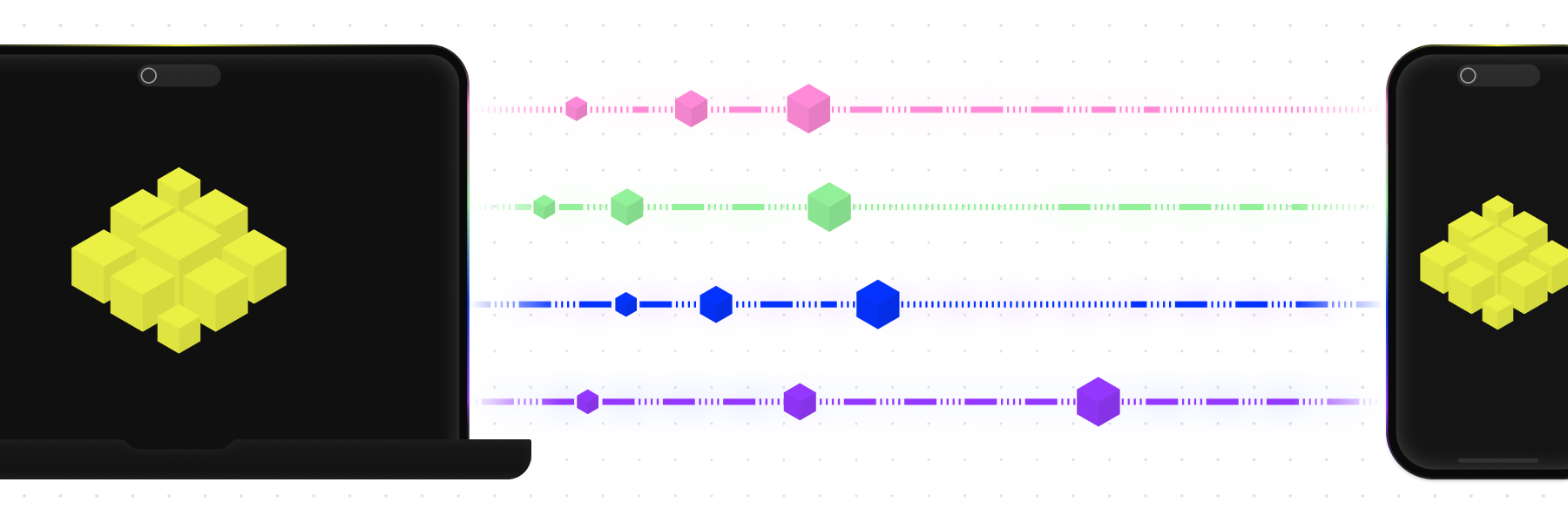
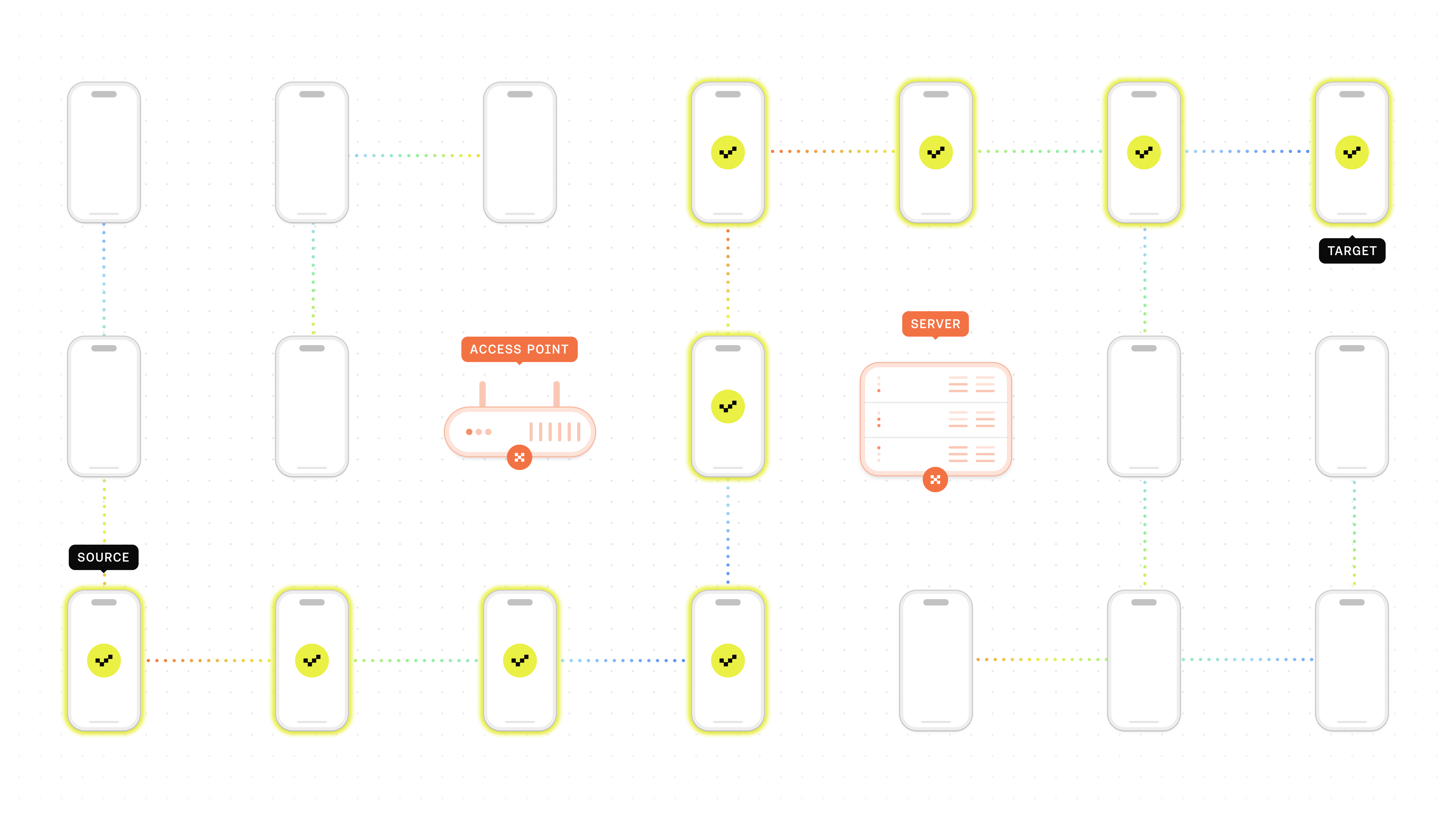
Mobile developers face a harsh reality: traditional data synchronization breaks down the moment network conditions become unpredictable. Ditto solves this through intelligent transport multiplexing, a technology that seamlessly switches between any active transports that your app supports in real-time. In Ditto’s case: WiFi, Bluetooth LE, peer-to-peer WiFi connections, and cellular networks. Instead of hoping one network stays reliable, Ditto provides redundancy by default by maintaining multiple simultaneous connections and automatically selecting the optimal path for every data transfer.
The Fatal Flaw in Traditional Sync Architecture
Most mobile sync solutions bet everything on a single network transport. They assume WiFi will always be available, cellular coverage will remain strong, or Bluetooth connections will stay stable. This assumption creates catastrophic failures in real-world deployments.
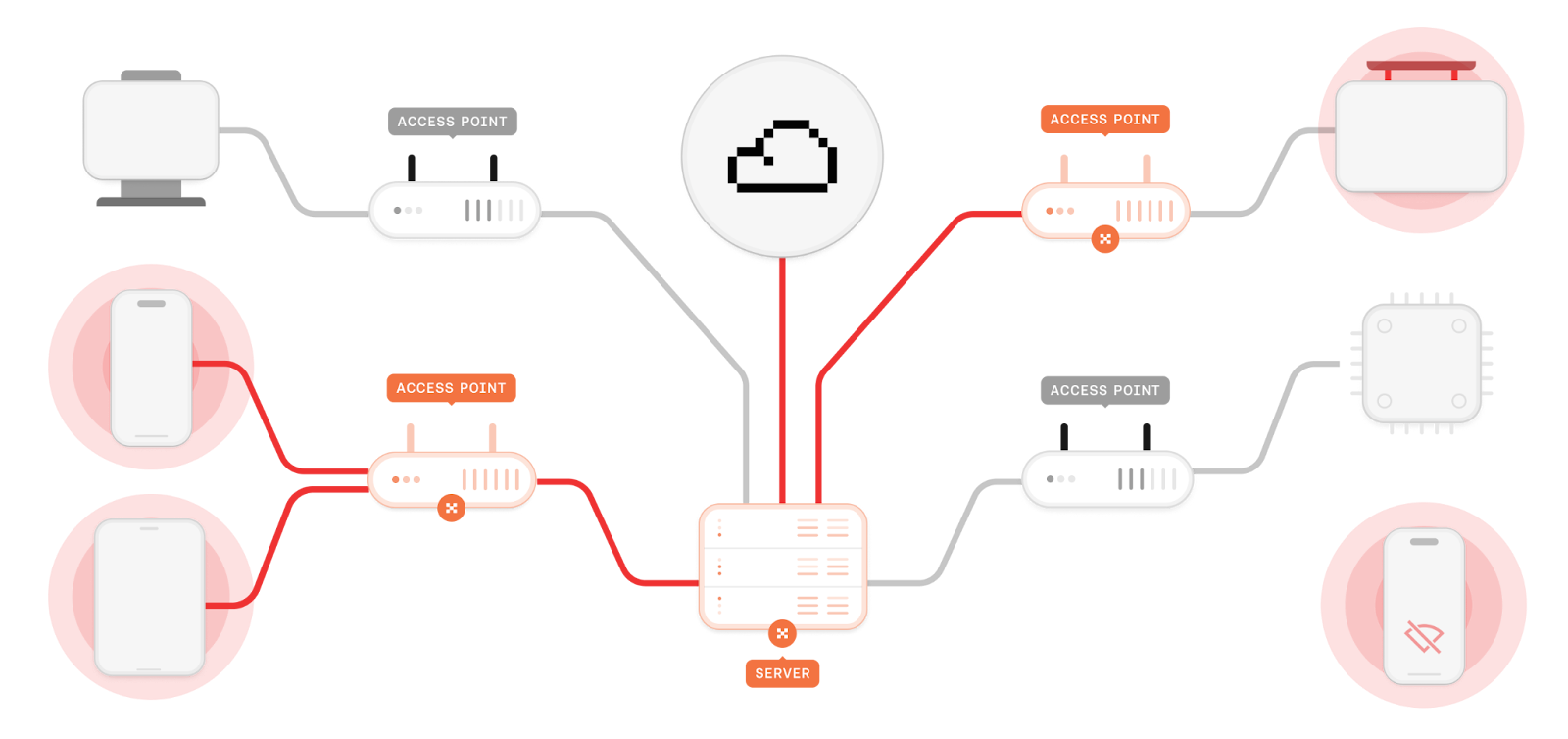
Consider what happens when airline maintenance crews move from connected hangars to aircraft on remote tarmac positions. Traditional WiFi-dependent sync immediately fails. Teams lose access to critical maintenance records, parts inventories, and safety checklists precisely when accurate data matters most.
Consider what happens when servers in a restaurant move from dining rooms packed with access points outdoors to the edge of the patio. Traditional WiFi-dependent sync may fail. Teams lose access to business-critical data such as menus, and orders may not be able to sync to the kitchen. Many solve this problem by installing WiFi access points outdoors but this is inefficient, costly, and ultimately wasteful as outdoor access points are replaced significantly more often.
Ditto thinks differently. We want businesses to use the best type of transport for any given situation. When businesses rely too heavily on WiFi for every situation, they are essentially forcing a square peg into a round hole. Ditto eliminates this single point of failure problem by operating across all available transports simultaneously. When servers move beyond WiFi range, Ditto automatically switches to peer-to-peer connections (think Airdop technology) between nearby devices. If those devices separate, Bluetooth LE maintains sync for essential updates. The application never loses data access because Ditto's multiplexer continuously evaluates and selects the best available transport.
%20Advanced.jpg)
Breaking Free from Infrastructure Dependencies
Traditional sync architectures require constant infrastructure: access points, cellular towers, or internet connectivity. This dependency creates vulnerabilities that compound in challenging environments.
Ditto's mesh networking fundamentally changes this equation. Instead of depending on infrastructure, devices form self-organizing networks using whatever connectivity exists. When hospital WiFi becomes overloaded, Ditto automatically creates peer-to-peer connections between nearby devices using Apple's AWDL on iOS devices or WiFi Aware on Android. Medical teams maintain full data access because Ditto treats infrastructure as optional, not required.
People don't have time to configure complex networking between devices, they need to focus on their actual work. When devices require pairing codes, authentication steps, or manual network setup, productivity stops while users fumble through technical processes they shouldn't need to understand.
Ditto eliminates configuration entirely through automatic peer discovery. Devices with the same App ID immediately recognize each other and form mesh networks without any user intervention. No pairing, no passwords, no configuration screens. The mesh self-organizes and self-heals as devices move, maintaining connectivity automatically in the background while users stay focused on the tasks that matter.
Solving the Bandwidth-Range Tradeoff
Network technologies force developers to choose between competing priorities. WiFi delivers high bandwidth but limited range. Bluetooth LE extends range while constraining bandwidth. Cellular provides coverage but introduces cost and latency. Traditional architectures lock developers into one choice, accepting its limitations permanently.
Retail inventory management illustrates this constraint. Store associates need high-bandwidth sync for product images and detailed inventory data when near WiFi access points. But they also need basic inventory updates when checking stock in loading docks, storage areas, or outdoor garden centers where WiFi doesn't reach.
Ditto's transport multiplexer eliminates this false choice. Associates near WiFi access points automatically receive full-resolution product images and complete inventory details at maximum speed. As they move toward storage areas, Ditto seamlessly transitions to peer-to-peer WiFi for continued high-bandwidth sync with nearby devices. In remote areas, Bluetooth LE maintains essential inventory updates. The same application adapts to every scenario without configuration or user intervention.
Automatic Conflict Resolution Without Central Servers
Distributed teams inevitably create data conflicts when multiple users edit the same information simultaneously. Traditional sync systems require central servers to arbitrate these conflicts, making offline operation impossible.
Ditto integrates Conflict-Free Replicated Data Types (CRDTs) directly into its sync engine. When multiple devices update the same data, Ditto automatically merges all changes using deterministic algorithms. Every device converges to the same final state without requiring server arbitration.
But traditional CRDT implementations have a critical weakness: they transmit entire documents with every update. When a user changes a single field in a large record, conventional CRDTs send the complete document across the network. This creates severe performance problems on slower connections like Bluetooth LE or congested WiFi, where bandwidth constraints turn simple updates into synchronization bottlenecks.
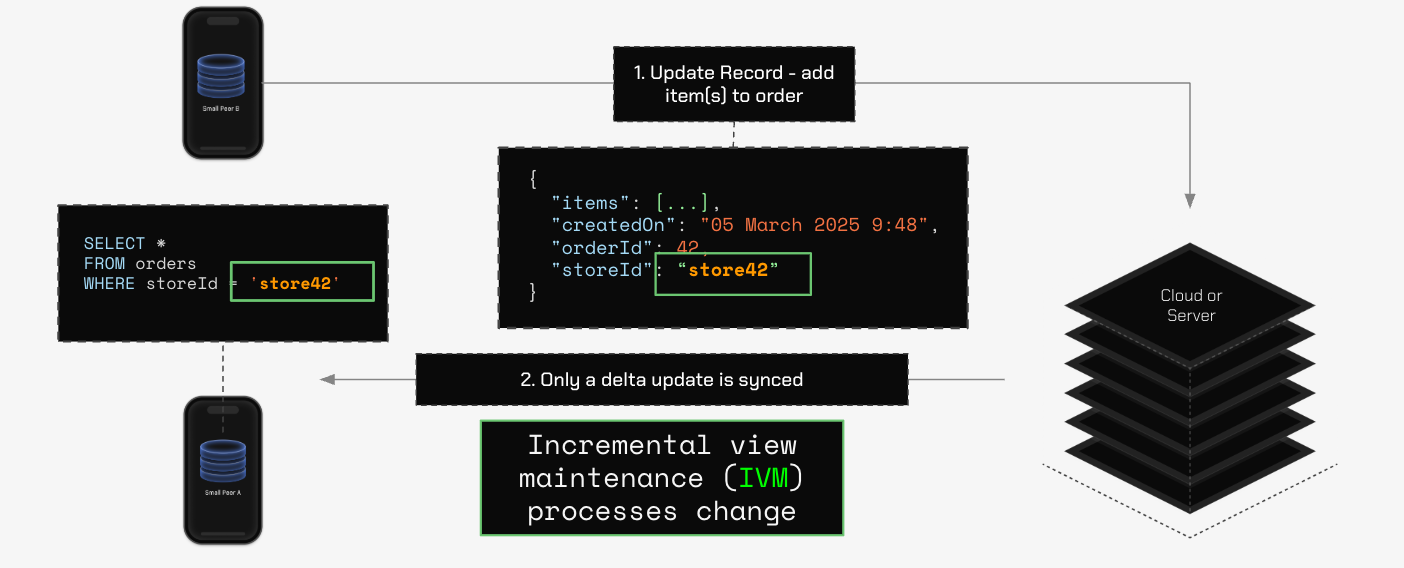
Ditto solves this by transmitting only delta changes, the specific field properties that actually changed. When a user updates one field, Ditto sends only that field's new value, not the entire document. This granular approach dramatically reduces network traffic and enables smooth synchronization even across constrained connections. Updates preserve their intent while maintaining consistency across the entire team, without the bandwidth overhead that cripples traditional CRDT implementations.
Intelligent Data Prioritization Across Constrained Networks
Synchronizing everything to every device wastes bandwidth and battery life—critical resources in mobile environments. Yet traditional sync systems lack intelligence about what data matters to which users.
Restaurant chains demonstrate this challenge perfectly. A chain with hundreds of locations generates thousands of orders daily across all restaurants. Kitchen display systems need real-time updates for active orders at their specific location. Managers need today's metrics, not historical data from other locations. Syncing all orders from all restaurants to every device would overwhelm local networks during peak service hours.
Ditto's subscription-based syncing solves this through declarative queries. Kitchen displays subscribe only to active orders for their restaurant location. Ditto automatically propagates only relevant changes to each device, reducing network traffic by orders of magnitude. When a server's handheld syncs over Bluetooth LE during a busy dinner rush, Ditto sends only the delta changes for their specific tables, not the entire restaurant's order history. This selective sync ensures smooth operations even when the restaurant's WiFi becomes congested with guest traffic and payment processing.
Platform-Native Performance Without Compromise
Cross-platform solutions typically sacrifice native performance for compatibility. Transport protocols that work on iOS may not exist on Android. Optimizations for one platform become limitations on another.
Ditto takes the opposite approach: native implementations for every platform that leverage each system's best capabilities. iOS applications use Apple's AWDL for high-performance peer-to-peer networking. Android applications utilize WiFi Aware and WiFi Direct when available. Web applications operate through WebSockets. Each platform runs optimized native code, not generic abstractions.
This platform-specific optimization extends across Ditto's entire SDK portfolio: Swift for iOS/MacOS/iPadOS, Kotlin for Android/Multiplatform, JavaScript/Typescript for web, React Native, Flutter/Dart, and .NET for cross-platform mobile, C++ for embedded systems and Android, Rust for performance-critical applications, and more. Development teams use familiar tools and languages while Ditto handles the complexity of cross-platform mesh networking.
Measurable Impact in Production Deployments
Organizations deploying Ditto report transformative improvements in operational reliability. Airlines eliminated data availability gaps. Restaurants sync orders and deliver food through internet failures.
These aren't incremental improvements, they represent fundamental capability changes. Operations that were impossible with traditional sync become routine with Ditto's transport multiplexing. Teams stop planning around network limitations and start focusing on their actual work.
Getting Started with Resilient Sync
For teams building mission-critical mobile applications, Ditto transforms unreliable networks from a constraint into a solved problem. Your applications gain infrastructure-grade resilience without infrastructure dependencies, maintaining full functionality wherever your users operate.
The era of hoping networks remain stable has ended. With Ditto's intelligent transport multiplexing, mobile applications finally achieve the resilience that field operations demand. Start building unbreakable sync into your applications today.